Sunday, November 20, 2011

On Netflixification

I read an article not too long ago-- but long enough ago that I cannot remember where and thus cannot provide a link (or remember anything quotable to retrieve it from the Google)-- that tried to make Netflix out to be a cultural problem. Basically, the gist of the argument was that because Netflix's streaming offerings are largely made up of junk that's either been long forgotten or quite quickly forgotten after a not-so-successful theatrical run, people are watching more junk instead of cinematic morsels. The author also threw in the dangers of having Netflix as our cultural feeder, or big brother deciding what we're going to watch. Finally, I believe the article ended with a tear about this is somehow hindering connoisseurs from digging up early '90s experimental films with someone crying in the wrong end of a saxophone as the soundtrack.

To this, I say: hogwash.

I'm certainly sympathetic to complaints about Netflix's recent service hiccups (i.e., the big price increase for DVD/BluRay rentals and its abandoned move to separating streaming and mail service, both resulting in a noticeable loss of customers), but the author flailed from the outset, and failed entirely to see the other side of the coin.

Although the streaming offerings have a long way to go to match Netflix's disc-by-mail offerings (which, by the way, I still happily pay for, plus extra to get BluRay discs), the streaming offerings are still among many options. Instead of working through 50-100+ channels, it's on-demand. And it's great. So, while I agree that far too many people went "Ooo" when they saw The Siege or A Knight's Tale pop up on the "New Movies to Watch Instantly" line this weekend, isn't this nevertheless miles ahead of basic cable, which kept both of these movies alive for years and arguably drew more viewers because the only other offerings were, well, basic cable?

But it's the options themselves that are the clincher: Netflix streaming is growing in quality, and the alternatives to Bruce Willis on autopilot are already many. The other week a friend asked for a list of good movies on Netflix streaming, and I was quickly able to come up with quite a long one-- long enough to know there were things he definitely had not seen.


For serious: Whit Stillman's Metropolitan is now streaming on Netflix. Why are you reading my blog when you could be watching this?


But why limit the joy to my friend? Here's the list, trimmed down to 25:

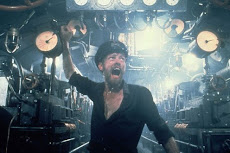
1.) Downfall (2004)
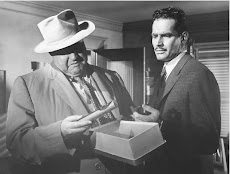
2.) Chinatown (1974)
3.) The Thing (1982)
4.) Trainspotting (1996)
5.) The Lost Boys (1987)
6.) This is Spinal Tap (1984)
7.) The Way Back (2010)
9.) La Femme Nikita (1991)
10.) The Last Emperor (1987)
11.) Mad Max (1979)
14.) 21 Grams (2003)
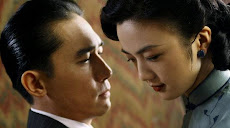
15.) Lust, Caution (2007)
16.) Metropolitan (1990)
18.) Kagemusha (1980)
19.) Doctor Zhivago (1965)
20.) Nowhere in Africa (2001)
24.) Zero Effect (2002)

And this is just feature films. I cannot begin to praise what Netflix has done with current and past television: the first season of Upstairs/Downstairs (1971) is streaming right now, as is more recent (and excellent) fare like the first four seasons of Mad Men.

Like all things Netflix streaming, the availability of these movies is not guaranteed to last, but I've confirmed that they're all still up there at the time of this posting.

Perhaps a lot of this is being lost amidst all the junk that's available on streaming but, again, these distractions are nothing worse than what they always were. The fact remains that for about 10 bucks a month (on top of internet and/or phone service) one can now stream excellent films on demand right to one's home. No fighting over the only copy at the library/video store. No worries about risking your Criterion copy as a loner disc. There's still room for improvement, but Netflixification is as right as entertainment gets.

(It's also worth noting that for the uber independent types, that's what YouTube is for.)

Sunday, September 18, 2011

Ryan Gosling, the Meditative Visage, and "Drive"


I wanted to like Drive. I still want to like Drive. I just don't see it working out.

There is a certain timelessness about films featuring a nameless driver. Clive Owen broke into American films in large part because of his role as the Driver, or "The Hire," in the BMW Films, a series of short films released almost a decade ago. (My favorites are Guy Ritchie's and Tony Scott's, both of which make very creative use of pop stars as actors.) Even just providing a good car chase with a named driver (or drivers)--as seen in Bullitt (1968), The French Connection (1971), Ronin (1998), and Gone in 60 Seconds (and this is one of the few films where I appreciate the original and the remake)--can make an otherwise decent film iconic.

Drive features two great car chases, with Ryan Gosling's nameless driver at the wheel. Both of these chases win points for realism and the second sets a new bar for intensity. Especially with accurate use of sound (namely, making it cringingly loud when it needs to be), director Nicolas Refn achieves energy that even the back-and-forth of machine guns (even rocket launchers) in Ronin cannot match.

This does not just apply to the car chases. The first gunshots that ring out in Drive are, with theater surround sound, as loud as real gunshots. Sound also defines what I really loved about Drive, namely its score by Cliff Martinez and soundtrack including electronic artists Kavinsky and College. Featuring a distinctly '80s font in the title sequence along with Kavinsky's "Nightcall" is an effective homage to the work of Michael Mann and William Friedkin: as a fanboy of both (especially To Live and Die in LA and Manhunter), of course I loved this.

But remember what I said about making an otherwise decent film iconic with a good car chase? Well, it's the "otherwise decent" part that's missing here.

It took me awhile to warm up to Ryan Gosling, namely because of an independent film called The United States of Leland from 2003. Admittedly, looking down his filmography on IMDb I have not seen many of his films other than largely forgettable (dues-paying?) fare like Murder by Numbers (2002). This does not mean I don't respect him: he was outstanding Crazy, Stupid, Love earlier this summer. His talent, though, does not include what I call "the meditative visage."

In my last post I gave credit to George Clooney at the closing of Michael Clayton. In that scene we're privy to a man absorbing all he's just been through (including an attempt on his life) for a good few minutes of silence (with a score behind it, of course). And it works. In one of my favorite movies that I don't watch often enough, The Limey, Terence Stamp spends much of the movie in silence, the look on his face conveying a character carrying too much remorse, guilt, and other baggage. The audience shares it with him. Sofia Coppola is regarded (or should be) as the master director of the meditative visage: she treated us to ensembles Bill Murray and Scarlett Johansson in Lost in Translation and, more recently, Stephen Dorff and Elle Fanning in Somewhere. The characters in these films keep silence individually and with one another, and not only keep our attention but further evoke our sympathy, empathy and--somehow--understanding.

Gosling tries this in Drive, along with his sort-of love interest Irene, played by Carey Mulligan. To borrow a phrase, it's like watching paint dry. Gosling is a mysterious driver who's looking for more out of life. Irene got pregnant at a young age by a recently released convict who she does not love. That's. About. It. It's laughable and boring to watch these two stare at one another with somewhat-but-not-quite longing, and it happens again and again in far too many scenes. It doesn't look like they're carrying anything more than the desire to not start cracking up in front of the camera.

I don't remember much about United States of Leland other than far-too-long shots steadied on Gosling's face as he thinks things over. If this is only the second time Gosling has taken a shot at meditative vision, fine, but to me he's run out of ammo. He can do better than this--as can Carey Mulligan.

Much like character studies, what works and what doesn't is not going to be set apart by a formula, and that's why film making is more art than engineering. But if one is going to look for examples for pulling off meditative vision, Drive is one that screams what not to do.

Monday, September 12, 2011

Feel-Good End Credits

They don't make them like this very often. Alas.


The Last Days of Disco (1998). Director Whit Stillman said goodbye to film making for for 13 years, and he could not have done it better.


The Adventures of Buckaroo Banzai Across the 8th Dimension (1984). We're still waiting for that much-anticipated sequel that's mentioned here, but given the way it's wrapped up all is forgiven.


Ferris Bueller's Day Off (1986). Poor Rooney. Almost.

Honorable Mention: Michael Clayton (2007). Alas, the only good YouTube capture I could find was disabled from embedding, but is available here. Not exactly feel-good per se, but pretty darn moving, even understanding George Clooney's pretentiousness.

Tuesday, May 3, 2011

Love / Hate Character Studies


An individual character study is a difficult cinematic feat. Especially when facing an American audience, directors seldom have a prayer of pleasing both moviegoers and mainstream critics. The result is often polarized, and that's not going to do directors any favors come awards season.

The right ensemble piece can be almost as magical as an individual character study: so it goes with standouts like Whit Stillman's Metropolitan, Kevin Smith's Clerks, and even (I daresay) Tarantino's Reservoir Dogs. (It's worth noting that all of these are independent films.) Given that just about any movie with more than one recognizable character could be called an "ensemble," I should clarify that my definition should only encompass character-driven stories. That definition is still more broad than I'd like, but it should keep Independence Day and Transformers out, which is about all I'm concerned with. Despite the effort required for a good ensemble piece, an individual character study--whether running 90 minutes or a 2+ hours--is far trickier, and often turns out flawed.

Americans played little or no part in crafting early cinematic character studies. We loved our epics, and we loved our ensembles, and no one thought better of it until the 1970s. By then, Kurosawa's Ikiru (a still from which adorns the upper left corner of this blog) was almost two decades old, and French New Wave was away to the races with everything from The 400 Blows to Le Samourai.

The '70s set the standard for America, a high bar that I personally haven't seen reached since. I've posted previously about Dude (not to be confused with Bro)-films, and two of these might fit the bill for character studies: High Fidelity and About Schmidt, mostly the latter. But even a good chunk of Warren Schmidt's journey is driven more by events in his life, not deliberate introspection or meandering. We leave that to one of Jack Nicholson's early defining performances in Bob Rafelson's Five Easy Pieces. (Oddly enough, a bright shining star in the career of a director who otherwise did little but help Nicholson pay for the Learjet.)

What makes Five Easy Pieces work? To be frank: beats the heck outta me. But comparing it to a similar and more recent film, Greenberg, helps to clear it up.

The individual-driven story is rare today, so rare that Noah Baumbach made a rather big deal out of trying it when he wrote and directed Greenberg just last year. In Greenberg, Ben Stiller plays Roger Greenberg, a musician who never made it. He had the opportunity to sign a record deal with his band, but turned it down in the name of artistic purity. Now he's a misanthrope, and has returned to L.A. after a long residence in New York to house-sit for his more grounded and successful brother.

Juxtapose this with Five Easy Pieces: Jack Nicholson plays Robert Dupea, a musician who could have made it, but walked away from being a pianist. He's a misanthrope, and returns to his home in the Pacific Northwest to visit his dying father and see his more grounded and reasonably successful siblings.

The tones of the film are entirely different-- Ben Stiller has yet to break into a truly dramatic performance-- but the characters themselves are not. They look the past with a good amount of disdain, have little regard for their futures, and cannot seem to figure out why. Plenty of decent people would like to see either of these aged adolescents taken to the woodshed, yet their aimless yearning (or yearning aimlessness?) draws enough sympathy-- I say empathy-- to be likeable, even loveable. We all have these existential crises, these men have simply embraced them.

Nevertheless, Greenberg's story wanders far too much and settles into a romantic angle that fails to enthrall, much less convince. Rather than grow out of his funk or far beyond a few petty realizations (e.g., that he owed it to his band mates to consult with them before turning down the record deal), Greenberg finds Florence (Greta Gerwig) and they fall into a cliche "I'm OK / You're OK" relationship that will of course fail, but since the movie ends before this can happen it's not supposed to be too much of a concern. If Baumbach had made this film on the heels of Kicking and Screaming, he may have had more success, but to make such a dated film a clear decade after the '90s ended hints that a biography of Baumbach himself may be more compelling than his contrived Roger Greenberg.

Five Easy Pieces suffers no such flaws. The weight Robert Dupea carries-- a never-quite-articulated combination of guilt, fear, and anger-- burdens him throughout. Instead of a fake band-aid to treat the bad feelings, the audience never even gets the full diagnosis. We're treated to a pretty good idea, capped off with this monologue (God bless YouTube and fair use):


"We both know that I was never really that good at it, anyway."

Maybe it's story, maybe it's actors, maybe it's subtlety, maybe it's all of these and more. There obviously isn't a set formula, since character studies are so tricky and, like Greenberg, just don't work. But when they do work? Stand back. Or, literally, sit back and savor the show.

Sunday, January 23, 2011

Movies I Should Loathe, but Instead Love: The Wraith

The Academy gave Matt Damon and Ben Affleck an award for the screenplay of Good Will Hunting. Each year somewhere around 1 million American college freshmen males adorn their dorm room walls with at least one Scarface poster. Fight Club is considered philosophical in some circles. In short, nobody's perfect. With this in mind, I present a series of objectively terrible films that I will gladly watch just about any time, anywhere. As with that "OTOH, Remakes" series I began in July 2009 and have not revisited since, this series may be short-lived. Consider it a New Year's resolution to make this one more fruitful, and consider that resolution as reliable as any New Year's resolution.

Installment 1: The Wraith

Just one month before Charlie Sheen launched his A-List leading-man career in Platoon (and a year before sealing the deal with Wall Street), he was greatly angering one already stern-looking Nick Cassavetes, wooing a perfect 10 Sherilyn Fenn*, giving Clint Howard a chance to show off that pre-total-bald-dome white-dude 'fro, and otherwise letting Randy Quaid enjoy a well-deserved break between his busy National Lampoon's _____ Vacation schedule.


"A Wraith, man! A Ghost! An evil spirit and it ain't cool."

In the mid-1980s southwest U.S., a band of hooligans runs the highways. Led by Packard Walsh (Cassavetes), they prey upon unsuspecting teens in sports cars (that is, what passed for sports cars in the 1980s) and force them to race. "If you lose the race, you lose your car!" The legal technicalities of gaming law and contract law aside, this allows for the hooligans to keep the losing car fair and square. And before you write this off as "boys will be boys," please note: the hooligans cheat when they race.

Packard isn't just a sociopath on the road, he's also got problems communicating. When Keri Johnson (Fenn) rejected his advances in favor of her boyfriend Jamie (Sheen, but played by Christopher Bradley in flashbacks), Packard killed Jamie with the help of his gang. Keri has nearly recovered from the horrific episode, but just as Packard seems to be settling in as king of the Arizona backdesert, a mysterious Jake (Sheen) arrives in town, quickly putting the moves on Keri and wooing her in ways Packard cannot muster due to his salty disposition.

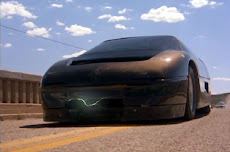
About the same time as Jake's arrival, a mysterious , futuristic car appears to challenge the hooligans. One by one, this car-- this wraith-- exacts certain death on the gang members involved in Jamie's death. Sheriff Loomis (Quaid), mysteriously absent any time Packard is stealing cars via street racing or until after the Wraith has claimed a victim, pieces together the solution to the riddle at a distance. He is the one bulwark of wisdom among the premium-fueled, deadly adolescence.

The Wraith, in addition to my previous jabs in the plot summary, is largely an amalgamation of a soundtrack featuring Billy Idol and other '80s hair, physics that allows four-banger Dodge Daytonas to keep up with supposedly supercharged Corvettes, and a rather meandering plot connecting frivolous action sequences between scenes of country bumpkins like Sheriff Loomis standing around just letting the Wraith do his business with looks of deep contemplation. There's also some serious drug abuse (of the "huffing" variety, if I recall my D.A.R.E. education correctly) by two of the holligans, aptly named "Skank" and "Gutterboy."

So, this begs the question, why do I love this movie?

Did I already say "Sherilyn Fenn?"

Keri (Fenn) confides to Jake (Sheen) that
she enjoys Dostoevsky and political discussion.


One element is certainly nostalgia. When I was growing up in the early 1990s, Wraith was often shown as a Saturday afternoon movie on TV, but I always caught it at the half way point. Even upon reaching college, The Wraith did not get a DVD release until well into the 2000s. Even then, it was bundled together with The Gate, some Trick-or-Treat movie with Ozzy Osborne and at least one other movie I certainly wasn't going to watch. (For the record: a Special Edition of the Wraith was finally released on DVD in March 2010.) Does my quest to see The Wraith in its entirety suggest that the film represents not so much a destination, but a long fond journey? Well, maybe so. Maybe so.

In actuality: this movie is fun. The Wraith was not the first or last cobbled-together story with young actors of varying talent that was considered by producers a success if it just brought in a few hundred thousand profit (which it did, holla), but it has some gems. Rip on Billy Idol all you want, but the music works to the pent-up teen angst and especially for car races. The special effects are actually quite stellar for a $2.7 million movie-- and still look pretty good today. The Wraith car itself is pretty stinkin' cool, and the writers do not attempt to explain Jamie / Jake's resurrection-- he's just there. Just the right aura of mystery, unconcerned with confusing the audience that might want to know everything.

I love The Wraith. There, I said it.

*"Marry me, Sherilyn Fenn circa 1986" almost equals "Marry me, Grace Kelly circa 1954."

Monday, January 10, 2011

True Grit: Some Carry the Fire

Four Coen Brothers films ago, No Country for Old Men ended very closely to Cormac McCarthy’s novel, with a monologue by Sherriff Ed Tom Bell (played by Tommy Lee Jones in the film) recounting a dream about his father. This comes just after Bell avoids—perhaps deliberately—a confrontation with Anton Chigurh (Javier Bardem), one of the most merciless villains ever conceived. Bell describes to his wife

[I]t was like we was both back in older times and I was on horseback goin' through the mountains of a night. Goin' through this pass in the mountains. It was cold and there was snow on the ground and he rode past me and kept on goin'. Never said nothin' goin' by. He just rode on past... and he had his blanket wrapped around him and his head down and when he rode past I seen he was carryin' fire in a horn the way people used to do and I could see the horn from the light inside of it. 'Bout the color of the moon. And in the dream I knew that he was goin' on ahead and he was fixin' to make a fire somewhere out there in all that dark and all that cold, and I knew that whenever I got there he would be there. And then I woke up.

The ideal father, strong and resolute, would not have avoided Chigurh. On the other hand, perhaps with that stark last line Bell believes this dream is just that: maybe no one would really have the grit to take on the pure evil of Chigurh.

Cormac McCarthy went on to write The Road, a popular novel with a recent, decent film adaptation of its own, that redeemed the bitter ending of No Country. In Road’s post-apocalyptic future, a father and son travel through the worst of mankind, and the father carries the proverbial fire with all of the resolve that Bell could only dream of. The Coens were not involved in the film adaptation of The Road, but they may have provided their own addendum to No Country for Old Men with their latest film, the remake (or re-envisioning) of Charles Portis’s novel True Grit. The film delivers up a hero with the selflessness that we longed for in No Country and received in the The Road.

Jeff Bridges plays Rooster Cogburn, an aged Arkansas lawman whose reputation leads young Mattie Ross (Hailee Steinfeld) to offer him a reward to track down Tom Chaney (Josh Brolin), the man who murdered Mattie’s father. LaBoeuf (Matt Damon) is a Texas Ranger who is already pursuing Chaney for a different murder, and he teams up with Cogburn, though their relationship is tenuous at best. Already an impressively confident 14-year-old girl, Mattie’s resolve to join the two men on the hunt is proven when she fords a river with her horse in order to catch up with him. But despite her young grit, the violence—often outright barbarism— that pervades the Indian lands where Chaney has fled is still new to her; she has a long way to go to attaining true grit.

There are a number of things to admire in this True Grit. There is not one bad performance. The Coens give us yet another very amusing court room scene, as they did in Intolerable Cruelty, where Cogburn’s no-nonsense answers to a recent arrest gone wrong introduce his character and humorously play off of the doctrine that prohibits attorneys from asking leading questions. As in some of their best films, the Coens also are unafraid to use the language of the period, and play great jokes off of old manners and customs. The cinematography wants for nothing. But ultimately, as with any film, it’s the story, and in this case the heroism, that elevates True Grit to greatness.

Rooster Cogburn is far from perfect. A drunk, and an arrogant one, his heroism at the climax of the film (with details I will spare) is unexpected. After much macho, adolescent sparring with LaBoeuf and almost giving up the hunt for Chaney, we’re left with the impression that Cogburn’s best days may be behind him. But when the time comes, his selflessness is as unquestionable as it is visceral. Whether facing bandits or snakes, he is methodical and does not hesitate to act when he must. Cogburn is not as old as No Country’s Sherriff Bell, but he is well past his prime. Although he’s not Mattie’s father, he risks his life for her as we could only hope the best fathers would. The man lives up to his legend after all.

The Coens’ True Grit may redeem the despair of their No Country film as effectively as The Road novel did the No Country novel. Indeed, Cogburn could be that man in Sheriff Bell’s dream more easily than the father in The Road. But some uneasiness remains, at least for this critic: where are today’s heroes? Why can’t we have them now? No Country is a nearly modern setting, the 1980s, whereas True Grit is set in the early 1900s and The Road in a (hopefully) never-determined future. Many of the most popular films today cast off any realistic portrayals of heroes into the future or back into antiquity. Is our only hope that a radioactive spider might bite the good-hearted newspaper photographer?

To be sure, going back to The Odyssey, legends have a place in instilling virtue. But must the vast majority of today’s cinematic heroism be seldom relatable to reality? And even when the term “hero” is brought up, must we moviegoers really endure the title of being placed on the likes of Valerie Plame? Indeed, there are indicators of a desire to see more modern fare: the heroism shown in last year’s Hurt Locker might explain why it won the Best Picture Academy Award despite so few having heard of the film before it won.

True Grit is an excellent film and yet further proof that the Coens are among America’s most gifted filmmakers, and my only complaint is that hopefully the next hero they deliver up is someone we could actually know.

Wednesday, October 6, 2010

The Social Network: College Drama and All That Is Capitalism


Mark Zuckerberg is, apparently, about as socially inept as the average IT guy, the one who creates his own tech kingdom at your corporate branch, government agency, school, or wherever. Such is how Mark's portrayed The Social Network; "not an asshole, just someone who's trying to hard to be one." In either case, he's America's youngest billionaire, and his creation, Facebook, drastically changed, and continues to change, online interaction.

To start, I note one of Social Network's strongest attributes: consistent intensity. Don LaFontaine, throughout his career, had to narrate at least one summer movie trailer a year that required him to voice "This summer's ultimate thrillride!," but for me (and I believe most viewers) it's an autumn drama about a dot-com startup that actually keeps the heart racing, more effectively than most of those forgettable Keanu Reeves vehicles. It's been a few days since viewing, and this still stands out the most. The intensity gives me pause, though: intensity, on its own, does not a great film make (this is especially true with one of Fincher's earlier works, Fight Club), but it can leave the mind a bit over-enthused for awhile. Thus, this review might lack objectivity that will settle in once I've calmed down.

That said, I believe David Fincher has finally made a masterpiece, with the help of Jeff Cronenweth's cinematography, Trent Reznor on the score, and a perfectly assembled cast (yes, even with respect to Justin Timberlake).

The film's timeframe is fall 2003 through fall 2004. One evening, Mark Zuckerberg wanders back to his Harvard dorm room from a breakup (brought about by his inferiority complex and passing his self-loathing on to a girl who would sink to date him), and drunkenly starts a project to take his mind off of things. The result is "Facemash," a website that uses pictures of female students from different residence servers at Harvard and compares them in pairs, allowing visitors to choose which one is the more attractive of the two. The site is a smash hit for a day or two, with traffic that crashes the residence server and leads to discipline against Mark.

Up to this point, the use of fact in the film is outstanding: Zuckerberg (Jesse Eisenberg) narrates the creation of facemash word-for-word from Zuckerberg's actual blog that he kept at the time of creation.

Not surprisingly, in addition to near-expulsion for hacking residence servers, a website comparing women based on looks leaves Zuckerberg quite unpopular with many students at Harvard, and here Mark hoped that Facemash would garner him popularity that would get him into one of the college's elite private clubs (that is, fraternites with more money and no Greek letters). It doesn't, but it does get the attention of two elite Harvard rowers who are twin brothers, Cameron and Tyler Winklevoss. They want Mark to code their exclusive Harvard social networking site, HarvardConnect (later named ConnectU, a social network that failed).

Mark agrees, and so the stalling begins. It's crafted as a subtle story of revenge: if you can't join them, beat them. For two months, Mark e-mails updates to the brothers (and their partner, Divya Narendra), saying that everything is going smoothly. Just days before the Facebook launch, Mark pulls the plug on working for HarvardConnect. Let the lawsuits begin!

This is but one plotline: Mark also has differences from the outset (that eventually results in a separate lawsuit) with his initial CFO and friend, Eduardo Saverin. As Facebook blossoms, the tensions only become worse.

Mark is about 19 years old at this point, as are most of his business associates. The Winklevoss brothers are perhaps around 21. It takes the entrance of Sean Parker (Justin Timberlake), the seemingly washed-up founder of Napster, for an adult to come onto the scene. And he's around the ripe old age of 25.

College drama is easily forgotten by most: in college, conflicts disappear just as easily as they arise. Many adults never make better friends than the ones they had in college, because these are the guys and gals who knew them before they were somebody, who liked them even when there was nothing they could possibly get other than camaraderie. In college drama, all is easily forgiven. But what if college drama is worth billions of dollars? Such are the stakes in The Social Network; regardless of the film's historical accuracy, the lawsuits surrounding Facebook's origin continue even today.

Aside from fast-paced drama, I most appreciate Social Network's portrayal of the intensity of innovation. Harvard educated both Bill Gates and Mark Zuckerberg, though neither of them actually graduated. Two of America's richest entrepreneurs. Like Gates, Zuckerberg took ideas from others (in this case campus acquaintances, pre-existing websites (MySpace and Friendster were established before Facebook), etc.) and jumped on it. Perhaps the Winklevoss brothers did have the idea to make an exclusive online social network (restricting membership to college students with a ".edu" address for a specific college), but they handed it off to a kid and proceeded to sit on their hands and wait. Not surprisingly, they missed the bus (but walked off from their first suit with somewhere around $60 million, and are still looking for more).

Capitalism, or the free market, gets blamed for lots of things. We're well past the age of Adam Smith, and live in an time where government spending (that is, spending tax dollars paid by residents who earned them) is believed to actually prime the economy, despite nearly a century of history that proves otherwise. Facebook is considered a marvel, and the company is held in high esteem by liberals and conservatives a like (people of all political stripes utilize it for their respective causes). Everyone loves innovation and invention, but those who oppose free markets fail to explain how their alternatives provide as much (or sometimes any) incentive to create new things.

Is Facebook really better for society? The debate continues, but it's definitely a hot commodity. And it's still free to use, in exchange for a whole lot of personal data. The fascinating aspect of Sean Parker's entrance is that until he tells Mark about the potential of Facebook (billions instead of millions), Mark is overly cautious, even timid. Facebook was not entirely Mark's baby, but he surrounded himself with largely the right people and, years later, Facebook is probably here to stay for quite some time.

Feelings get hurt in free markets. People fail (Exhibit A: Who even remembers the Winklevoss ConnectU?). The ones who succeed do so because they produce what people want. It's sometimes a messy business, business, but 99.9% of the time the ends to justify the means.

That other .1%? Let the courts figure it out. Lawyers gotta eat, too.