Saturday, March 13, 2010

The Miniseries: Where's the Love, America?

HBO begins a new miniseries this weekend, The Pacific. It's the first much-anticipated mini in America since, well, Band of Brothers. Once a decade, eh?

Considering that American critics often scoff at films with running times over three hours even in instances when such length is warranted, perhaps most non-HBO miniseries are doomed on arrival in the United States. On the other hand, the advent of TV-on-DVD and TiVo has led to plenty of weekend marathons: I know I'm not the only one who can plow through a 13-episode season of Mad Men or The Shield in two or three days (some prefer doing it one sitting). Given this not-too-uncommon approach, I think it's fair to give the miniseries a good plug. Long a staple in England and elsewhere, it's only in rare instances that a mini is produced in America or by Americans. As basic cable networks move more and more into original programming (e.g., both series I just mentioned), shorter seasons are required to ensure the right per-episode budget. Why not aim for more one-shot style programming?

Many minis come from novels, and a quick comparison shows that given the right amount of running time a novel can be adapted far more faithfully (i.e., better) than in a feature film. Jane Austen provides good examples: though the 127-minute Pride and Prejudice (2005) is quite good, it does not live up to the BBC's 300-minute mini of the same title (1995). Even Sense and Sensibility (1995), a bona fide Hollywood masterpiece, cedes ground to a more recent mini (2008). By way of introduction to my fellow American viewers, I offer three of my personal favorite minis:

Brideshead Revisited (1981)

Recently victimized by an awful Hollywood adaptation, Evelyn Waugh's novel of friendship, Catholicism, and the decay of the British aristocracy following World War I also enjoys the privilege (even 30 years later) of being standard-bearer for all other minis. "Spared no expense" does not always produce art (e.g., this, and, oh yeah, this), but for Brideshead it was essential. The dialogue and narration is taken almost verbatim from the novel and supplemented with cinematography that would better suit the big screen (especially considering the average size of televisions in 1981). Though only Jeremy Irons enjoys prominence in America today, the series also launched Anthony Andrews, who's continued to own almost every part since (my previous lazy post features a clip from Under the Volcano, a film that benefits from a small but integral supporting role by Andrews).

The story of Brideshead is a sort of bell curve that traces Charles Ryder's (Irons's) life from college through middle age and his experience with the Flytes, a very Catholic, very wealthy and very troubled family. It begins with a deep friendship between Charles and the youngest male Flyte, Sebastian (Andrews), but then transitions into Ryder's adulterous love for Sebastian's sister Julia. A descent from skeptical agnosticism to full-blown atheism parallels this. An otherwise self-indulgent lifestyle leaves one quite angry and unsympathetic to Charles.

The bell curve slowly inches down into despair, but it suddenly swoops up, prompted by the sudden re-appearance of God, Whom Charles made every (seemingly successful) effort to banish. This is shocking, even devastating, and one of the most realistic, faithful portrayals of Christianity put onto film. I suspect those with faith will recognize God's victory with relief, perhaps even relish, and only hope those who empathize with Charles's efforts to destroy God learn more of Christianity from their viewing experience rather than take it as mortar to keep building walls.

Band of Brothers (2001)

The jury is still out on The Pacific, but it has a lot to live up to. Even though Band of Brothers is one of the few American-financed minis, it was produced entirely in England. The work is adapted from a book by Stephen Ambrose of the same title, and it is very well-regarded (or at least heard of) by many TV-watching Americans.

The series follows the exploits of Easy Company of the 101st Airborne Division in World War II, from basic training through D-Day and all the way to the end of the war. Within this narrative are various stories of individuals, with most respective episodes focusing on different members of the company. Since this is such a popular series, and because its popularity will only spike again in light of The Pacific, there is not too much to add but my own recommendation. If you haven't watched Band of Brothers, do so.

The Last Place on Earth (1985)


In 1911, just prior to World War I, there were still parts of Earth unseen by man. One place was the South Pole. Roald Amundsen of Norway and Robert Scott of Great Britain both had their sights on this pole. Their respective attempts were nominally scientific expeditions, but there was no hiding the potential prestige that would come to the explorer who first conquered the Antarctic (not to mention his country). It was a race.

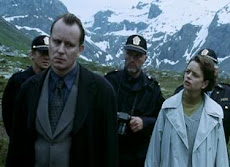
Like Brideshead, Last Place on Earth is perfected visual craftsmanship. Perhaps it's silly to say, but one can almost feel how cold it is in Antarctica just by watching. The acting, from lead roles by Martin Shaw (Scott) and Sverre Ousdal (Amundsen) down to a small supporting part by Hugh Grant (his second acting job) is excellent. And the story never lets up. Unlike the admittedly slow
(though that's not to say boring) pace of Jane Austen minis, even the less dramatic parts of the narrative convey tension, perhaps even dread: Antarctica is not a place to visit, but a force to be reckoned with.

Last Place on Earth pulls no punches against Scott and what I can only classify as his distinct pre-WWI British arrogance. Some reviewers have called some of this criticism unfair. Nevertheless, it is fascinating to see the difference between the explorers and their expeditions. Both take to the race with vigor, but only Amundsen appreciates the danger. The expeditions each face setbacks and danger, but where the Norwegians conquer the British blunder. Perhaps there is no better film that juxtaposes a narrative of victory and one of tragedy so well.

Each of these minis are 5/5 stars, and well-worth owning for repeated viewings.

As I mentioned earlier, the miniseries is unfortunately under-utilized.
I recently watched the made-for-TV Pirates of Silicon Valley and think it had all the makings of a miniseries, but was instead crammed into about 90 minutes. Even then, some stories that are made into minis (like ESPN's The Bronx is Burning) are so crammed with commercials they hardly ever get around to telling a coherent story (though, for sports fans, perhaps quick-burst clips are the way to go). Nevertheless, there are a number of great miniseries out there, and they live up to some of the best films.

Saturday, December 5, 2009

Cinematic Morsels, Courtesy of YouTube

Some lesser-known films I've seen recently (and even some popular ones) have made appearances on YouTube. I don't know what their respective public domain status is, but as long as they're up they serve as a quick preview (and far better than trailers in many instances) for movies some readers may be interested in.

Admittedly, I have some reservations about clip-dropping because they're out-of-context and thus don't give the full effect. But I just gotta. And if this doesn't lead to viewing the whole film, better you get a part than nothing at all.

Lacombe, Lucien (1974). The devastating ending of Louis Malle's epic. It's beautiful enough to stand on its own, but this film is a must-see:


(Link fixed 3-14-10)

Under the Volcano (1984). John Huston is best known for his films with Bogart, but his career lasted far past the 1940's and produced plenty of films of equal worth. Albert Finney's performance as a functioning alcoholic is the best I've ever seen:


Wise Blood (1979). More John Huston. Perhaps the best performance of Brad Dourif's career as Hazel Motes. I didn't believe Flannery O'Connor could be faithfully adapted to film. I was wrong:


Brazil (1985). Terry Gilliam's greatest work. Everyone should see this movie. This is what bureaucracy looks like:


Ikiru (1952). It's the time of year for regular It's a Wonderful Life screenings. Nothing wrong with that, but this year try a little Kurosawa instead:


(Link changed 3-14-10)

Feel free to link to others in the comments!

Sunday, October 25, 2009

A Load of B.S. - On the return of the Boondock Saints

I was not the first at Plymouth-Salem High School to discover The Boondock Saints around 1999. The film had a very limited theatrical release, and I don't believe Detroit or Ann Arbor fit the bill. Instead, Troy Duffy's cinematic orgy of death came to the Midwest via Blockbuster Video. With the cheaper printing of DVDs, many Blockbuster locations remain a great place to find direct-to-video trash like Cruel Intentions 3, while classics like Cool Hand Luke are only found in the online catalog.

On recommendation from the only other bona fide film buff in the tenth grade, I sought out the original and, like any 15-year-old Reservoir Dogs fan, fell in love. Vengeance, but in God's name. At the time I was impressed. Anyway, I was perhaps the second at Plymouth-Salem High School to discover Boondock Saints around 1999.

Ten years later, on the eve of the trailer for Boondock Saints 2: All Saints Day, I could officially opine "Who cares?"

Six guns. No aiming required.

Norman Reedus and Sean Patrick Flannery certainly look 10 years(+) older, and I'm sure the plot goes a long way towards explaining their prolonged absence, but it's very hard to give a vigilante story new flavor, especially in a series. The original film (like all vigilante films) plays off the worst of gut instinct: revenge. "If only someone would get these drug dealers, rapists, bartenders(?) off the streets, then things would be better." The law is not a solution to these problems, but a hindrance. Ambiguously called by the Lord to dish out a good dose of smite to the South Boston underworld, the McManus brothers (with the help of comedy well-worn with frat boys reciting "Taking your f****ing rope" for the past decade) proceed to "kill everyone." And, with their silly sidekick, a cat.

This kind of treatment can only stay fresh for so long. Rather than recognize the calamity that is sure to follow in any instance of prolonged vigilantism (that is, the collapse of the rule of law), the Saints are elevated to folk heroes-- the people we all wish we had the "guts" to be. Perhaps the sequel will add something new to the equation but, as deceiving as trailers may be in some cases, this doesn't appear to be such a case.

The two best films on vigilantism are Death Wish (1974) and Taxi Driver (1976). Both Paul Kersey (Charles Bronson) and Travis Bickle (Robert De Niro) are sociopaths, and the films take an honest approach to the derangement that leads to vigilantism and the lasting effects of such behavior. The four Death Wish sequels should serve enough of a warning to Troy Duffy to leave his original cult classic alone, but given that Duffy was actually let behind a camera again to begin with, we can't exactly expect him to branch out at this point.

Perhaps the hardest part for me is the illusion Boondock Saints projects like select other Hollywood films (such as Fight Club) that there's something clever or thought-provoking behind the story. There isn't. Unfortunately, references to God (and Marx) seem to have that effect of "Man, it just makes you think, you know?" Thinking about actually studying either subject? Fat chance. But maybe someday. Here's hoping.

I close with a little self-pat-on-the back for my previous post on the utter farce that is the Saw series. Sure enough, while I have only seen the first installment, the advertising for the sixth (!) film confirms just how simple-minded this pseudo-philosophical dirt really is:


Mindless entertainment indeed.

Sunday, August 16, 2009

District 9: Summer Goes Out with a Bang

District 9 is the best popcorn flick of summer 2009, beating out Star Trek because of its overall seriousness and, more importantly, freshness. Trek. Transformers. Terminator; even a "new" film (franchise? I hope not.) like GI Joe relates back to comic books and cartoons. Not without plenty of cliche sci-fi / action elements, District 9 is far from perfect, but I'm impressed.

Any Blade Runner fan eagerly awaits "serious" or "gritty" science fiction. Such fare usually only gets a major release once a decade: the 1990s had Dark City, and just a few years ago another minor miracle-- Children of Men-- marked what I thought would account for this decade. To be sure, there are plenty of other jewels out there, such as Strange Days, Code 46 and Gattaca, but these either did not see wide release or had very little promotion to back them up, and certainly did not collect blockbuster revenues. District 9 has wide release and major promotion (complete with "This Bus for Humans Only" signs on buses in major cities). I eagerly await the box office reports, but for an R-rated dark sci-fi this seems to be quite a gamble on Peter Jackson's part, and I thank him for it.

There is plenty to criticize about D-9. The film's documentary style starts out promising, but soon enough the audience sees scenes that are clearly not part of the documentary. It's not too difficult to tell these scenes apart, but nevertheless the narrative is a bit clumsy at points. Now-and-then, during long periods of not part-of-the-documentary, some shots are shown through security cameras or the like: although this may have been intended to increase the audience's feeling of paranoia, I think it's more of a fallback that screams "don't forget that documentary thing that's going on! The viewers of the documentary don't know this, but you do!" By the end of the film, when the documentary rears its head for the last time, I for one thought "ah, yes, the documentary. Nice to see you again, old friend."

Every sci-fi has some plot holes and requires suspension of disbelief, but the heavy-handed "Evil Corporation" plot line needs to be retired. Aliens arrive on earth, and a government is going to contract with a private corporation (with its own private army) to manage the population? Spare me. Furthermore, even though these aliens have been removed from their ship, many of them happen to have brought along (smuggled?) what appears to be thousands of alien weapons into District 9. These weapons cannot be used by humans (that's another part of the plot), but one has to wonder whether that would make any difference when herding these aliens off of their ship.

But, anyway... after all this, there's everything to love.

First, no big-name stars. For a summer blockbuster, this is exceptional, and here it's effective. There are some recognizable faces, but by and large District 9 is newcomers and b-list actors. The setting of Johannesburg, South Africa is heightened with a lack of recognizable faces.

Second, uncompromising special effects. Remember Terminator: Salvation a few months back? I still wince at the memory of some of the more mediocre effects. I stayed through the credits of D-9, and it looks as if every major effects studio in the biz had a part in making sure every effect in the film was seamlessly integrated. This has been a problem in film for some time: we've had believable computer animation for over a decade already, but the potential for flawlessness has, shockingly, seldom yielded flawless results. This is one of those seldom results: you will have to remind yourself it's not real. That's as right as SFX get.

Finally, the plot is not stupid or dumbed-down. Once again, this is not to say it's perfect and many of the plot's parallels are simply interesting rather than actually compelling. Apartheid has been over in South Africa for some time. Does dredging this up and proceeding to beat it up really teach anyone a lesson? (Super digression: this is one reason I'm not looking forward to next week's release of Inglourious Basterds: "They're killing Nazis with baseball bats. Haha. That's funny. Because Nazis deserve it! Get it!?" True, but not exactly amusing.) I really don't see the point. Otherwise, it's very well-constructed. Our protagonist acts, I believe, in the way most people would act if put in his situation. He is heroic, but reluctant. And when he finally steps up, it's in a far more plausible way than "Dad quit drinking and flew his fighter jet into the aliens' lazor at the last possible second! We're saved!")

Returning to where I began this review, the freshness of it all, especially after the last few years of summer blockbusters, cannot be denied. Someone actually wrote an original screenplay based only off of his own short film. No novels. No comic books. No "source material." Just in the short life of this blog, it appears every new film review (okay, both of them) suffers from this. I'm tired of comparisons to source material, previous installments, "the original", etc.

Everything's derivative to some extent, but District 9 plays, and well. Breathe that fresh air while you can.

Saturday, July 11, 2009

"OTOH, remakes..." Part 1: Manhunter / Red Dragon

Pardon my juvenile expression, but remakes tend to be giant turd-fests. I've said it before, but it's worth repeating. Recently, while channel surfing, I came across City of Angels. I last saw this when it was still a relatively new film, and long before viewing Wings of Desire (Der Himmel uber Berlin), on which the film is based. Although I did not view City of Angels in its entirety this time around, I'm left with the same conclusion: not bad.

Believe it or not, this is more disturbing to me than a turd-fest! It's an uneasiness, a queasiness... what if they're not as easy to distinguish as "artistic mastperiece" Rollerball (1975) from "why-does-Chris-Klein-secure-roles-thought-there-already-is-a-Keanu-Reeves" Rollerball (2002)? Wings of Desire is far superior to City of Angels, but I cannot not slam the latter in its entirety. It adds enough creative elements of its own to pass muster.

I set out to write a short intro, and next thing I know I'm thinking a post about the distressing New Age spiritual void portrayed by City of Angels is in order. Maybe someday. Today, rather, I start a series of posts on remakes that are not turd-fests, nor merely achieve "not bad." Rather, these remakes are nearly as good as, as good as, or, shockingly, even better, than the originals. I will balance my intense criticism of remakes in general by giving comeuppance to those few gems that pull it off. I don't know how long this series will last or the timing of future installments, but I assure you this will be a series. Ahem. I assure you that at the present time I think this will be a series. Fair enough?

Spoiler Warning: You can't do this right without 'em. Deal.

Tribute I: Manhunter / Red Dragon

Manhunter (1986)

About the time Miami Vice reached the peak of its popularity, its executive producer Michael Mann returned to the director's chair. He'd already established himself, not merely with Vice but with one of the most underrated films in the crime genre, Thief, a few years previously. Almost a decade later, he'd direct Heat, which is, thankfully, given a place on any respectable top-10 crime films list (on this critic's list it's just below Godfather II and Miller's Crossing). I note these films because, while Heat is treasured and Thief is overlooked, Manhunter is a buried treasure. Why? As near as I can tell, it's for the simple fact that it's a prequel to Silence of the Lambs and features the Hannibal Lecter character, but not Anthony Hopkins.

The "error" was, perhaps, so egregious that the novel Red Dragon was re-adapted in 2002, this time with Hopkins in the role. But I'm getting ahead of myself.

If a Manhunter is a sum of two parts, those two parts are Michael Mann's direction and William Petersen's acting. Mann has perhaps one of the best sets of eyes in Hollywood: even his recent mediocrities like Collateral and the Miami Vice movie were visually perfect (and arguably more fun watched on mute). William Petersen is quickly recognized as Gil Grissom from "CSI", but before striking it big his career was shockingly spotty. Outside of To Live and Die in LA, Manhunter, and the first American production of the play "Glengarry Glen Ross", he was seldom challenged and seldom shined. But when he shines, watch out.

The visuals in Manhunter speak for themselves. Not one shot is wasted. I'd share some samples, but screen capture has become ridiculously difficult these days, and I'm too poor to buy some software. Anyway, see it.

With that, let's begin the William Petersen tribute. Petersen's Will Graham is quite obviously messed up from the beginning of the film. What's his deal? Beautiful wife, son, and a gorgeous house on the beach, yet he's a shell of a man. It takes a special kind of skill, luck or combination to radiate this on screen. Graham is a retired FBI agent who, we learn, captured the notorious serial killer Hannibal Lecter. Now his expertise is needed again to capture a murderer known as The Tooth Fairy.

Graham's investigative methods are fascinating, but creepy. He wanders a crime scene, immersing himself in the killer's perspective, eerily coaxing out the Tooth Fairy's methods and, soon enough, finding cracks that could lead to his identity. By now the audience should figure out what kind of effects this kind of work can have on a man, but we're also sure there's something more. Needed guidance, Graham visits the killer he's already captured, Dr. Lecter, and by now we know the capture of Lecter was not exactly a Frank Columbo-style "gotcha!"

Brian Cox also deserves a deal of credit for his performance as Dr. Lecter. To be sure, Anthony Hopkins is rightfully celebrated for his performance in Silence of the Lambs and Red Dragon (I'll viscerate Hannibal in a later tangent), but Cox... whisper it... performs the role with equal skill. Put these to men on opposite sides of the bars and...
I know that I'm not smarter than you.
Then how did you catch me?

You had disadvantages.

What disadvantages?

You're insane.
You could cut the tension with a knife. It's a confrontation that trumps any by Jodie Foster (Silence of the Lambs), Julianne Moore (Hannibal) and, as we'll discuss later, Ed Norton.

Graham's investigation continues, and he teeters. He's afraid to commit because he has not recovered from taking down Lecter. This error endangers his family, and soon enough he's back in Florida hiding them in a safehouse. It's here where we finally get the full story as to exactly what happened to Will Graham when he took Lecter down. We're treated to this as a chat--almost a confrontation--between father and son, once Graham learns his son is afraid of him.
What happened?
Well, Lecter was attacking college girls, and he killed them.
How?
In bad ways.
This a clever plot device, and it fills in the gaps for the curious, but it also makes it abundantly clear that Graham has a gift, one that we wouldn't wish on anyone. This is not his job, or even his career; it's a calling. Graham is duty-bound to his family as a father, but bound to all the other families out there to stop the Tooth Fairy before he kills again.

The film builds up to a break. I'm happy to say that, despite my spoiler warning, I think I've kept this pretty particular without ruining anything, so the ending is perhaps best left alone. Suffice it to say, Manhunter's qualities abound, and considering many of these were perhaps driven by its less-than-stellar budget, I like it all the more.

Red Dragon (2002)

Hannibal (2001) was stupid. Stupid, stupid, stupid. A mess. And this is coming from a Ridley Scott fan, mind you. In short: the Lecter character transcended reality and became as believable as film slasher Michael Myers. The ending featured a series of gross-outs that played right only to the 16-year-olds who snuck into the film. There is no reason to discuss it, much less see it.

Fortunately, the box office for the film brought forth the remade prequel Red Dragon.

Red Dragon had to be distinct from Manhunter: though the latter is a cult film, the producers knew they had to distinguish it. And they had a bigger budget to play with, too. In doing so, they produced a film that stands on its own two feet and, more importantly, makes for a really fun comparison and contrasting. Nevertheless, with its added frills comes some failures.

To begin, Red Dragon does away with the Special Agent Graham / Lecter mystery by showing how Graham took Lecter down at the start of the film. This is a powerful opening, and it's perhaps Hopkins-Lecter at his most terrifying in any of the films. This makes for an easier transition to Graham living on the beach-- honestly, who can blame him?

It is with this opening scene and various others that Red Dragon shines, but the fascination for fans of the original wanes with what's largely unchanged. Although we see Graham meet Lecter immediately in Red Dragon, their encounter once Graham is on the Tooth Fairy's trail is stale. Norton attempts to add emphasis to Graham's lines that Petersen was wise to de-emphasize, and to little effect.

What's most unfortunate about Norton-Graham is that, while given the same lines as Petersen-Graham from Lecter about the traits he shares with serial killers, it's a hard sell. In fact, it's an impossible sell as Red Dragon continues. Lecter is not a minor character in Red Dragon, and where Graham in Manhunter sought out Lecter to "get the scent" back, Norton-Graham returns again, and again, and again. By the time the film reaches its first major climax Norton-Graham is not following the evidence, but simply what Lecter says about the evidence. Norton-Graham is really just along for the ride.

There comes a point where you might have to go be a detective, Graham.

Red Dragon's different approach to The Tooth Fairy, or Francis Dollarhyde, is far more successful. While in Manhunter we're introduced to the Tooth Fairy, ably portrayed by Tom Noonan, the sympathy we feel for the character is minimal. He's disturbed, to be sure, but we're not treated to a serious sense of struggle or, for that matter, to the extent of his insanity. Red Dragon takes the opposite approach: Ralph Fiennes gives us evil, but also conflict and a better look at the twisted fantasy behind his vile acts. Much is owed to Emily Watson, whose Reba McCLane almost unwittingly ends the Tooth Fairy's terror when she falls in love with him. It's a great approach: there are, indeed, those who commit crimes purely from insanity, but Red Dragon is not quite so heavy-handed as to excuse Dollarhyde. We may not sympathize, but we lament his choices.

My final note about Red Dragon is acknowledging its disadvantage: while Manhunter succeeded with a lack of budget, Red Dragon largely succeeded with a lack of direction. To his credit, Brett Ratner gets around as a director, producer, and occasional actor (as of this writing, he has 12 projects listed as "in development" on IMDB). Nevertheless, his track record as a director is dismal outside of Red Dragon. The Rush Hour films are all largely forgettable, and I've long considered The Family Man one of the closest things to cinematic Armageddon. (It is perhaps the total dishonesty of this film that makes City of Angels seem so not-bad.) Certain films with Edward Norton, such as American History X, were allegedly directed-in-fact by Norton himself, and I imagine Norton's influence was pervasive here, too.

All things considered, my preference for Manhunter comes from Graham's resolve. While Edward Norton's Graham ends up feeling sorry for the Tooth Fairy (far more than the audience, I believe), Petersen's is far less forgiving:
As a child, my heart bleeds for him. Someone took a little boy and turned him into a monster. But as an adult... as an adult, he's irredeemable. He butchers whole families to fulfill some sick fantasy. As an adult, I think someone should blow the sick fuck out of his socks.
May we all learn something from such an unequivocal limit on sympathy.
Italic

Wednesday, June 17, 2009

Chaos Theory? A Musing on Dude-Wins-Lady in Film. Or something.

I preface this post with the elementary disclaimer that, of course, you shouldn't necessarily mimic what you see on the screen. This is especially true if the movie is called Natural Born Killers. Nevertheless, there are many classical virtues and modern (sadly, malleable) values portrayed in films, some of which we should aim to display in either fantastic or not-so-fantastic situations. Granted, not many of us will get the chance to destroy an alien ship with an explosives-laden biplane before it zaps Area 51, but sacrifice is admirable even in a smaller situation such as, say, in a relationship.

It's unfortunate that virtues like "sacrifice" (or the fortitude behind it), which are good in and of themselves, don't always yield subjectively sweet results. One can be thankful our protagonists did their best, but the end can be a real bear. Take, for example, the smorgasbord of results in films revolving around the age-old theme of falling in love: They don't make movies like Roman Holiday anymore, in which duty supersedes individual happiness, because although some admire Gregory Peck, today's dude is never, ever going to give up Audrey Hepburn without a fight. Perhaps further exploration of notable Dude-Wins-Lady scenarios in film is in order. Or, at least, an attempt at figuring out how we've come so far from the Holiday.

1.) Love Story (1970)

"Love means never having to say your sorry." Gag me. I make no claims to being an expert on love, but this is perhaps the dumbest line in the history of film. I wish there was a way to count how many relationships that otherwise had a chance ended because of this line. Although it makes a few decent attempts to show how privileged kids can weather privileged storms (e.g., disapproving parents and their tired old religion, oh how quaint), the fact that the solution lies in a self-righteous platitude kills this example. Alas, this movie is regarded as a classic in some circles.

2.) Sixteen Candles (1984)

Shifting focus onto an actual dude, there's perhaps no one more aloof in the history of cinema than Jake Ryan (Michael Schoeffling). The object of Samantha Baker (Molly Ringwald)'s desire, men can take away the lesson that the key to a woman's heart is abs, a Porsche 944, a total disregard for our parents' homes (and its furnishings, good grief), and silence. Okay, so Samantha is barely 16 and by the time she made it to college Jake had probably moved on. He's probably living some sort of neuvo-Rabbit lifestyle in Wilkes Barre, Pennsylvania these days, and could throw a football over that mountain. Wait a minute, Samantha wins Jake. Wow. This exploration is not going well thus far.

3.) All the Real Girls (2003)


Player falls in love. Player changes for the better. Player gets dumped after being cheated on. This tragedy is far too realistic and I will never watch this movie again, and I'm not even a player. Perhaps love does mean never having to say your sorry, and human nature drives men and women alike to stomp all over significant others just to test the theory, at least until both sides meet their respective match. Maybe Paul Schneider does learn a valuable lesson, but it comes off as so darned nihilistic I just want to puke.

Now that this journey through bad romantic cinema has caused me to take ill, I must make a transition with a clever quotation that also references vomit:
Look, we're gonna spend half the night driving around the Hills looking for this one party, and you're going to say it sucks. And we're all gonna leave and then we're gonna go look for this other party. But all the parties and all the bars, they all suck. I spend half the night talking to some girl who's looking around the room to see if there's somebody else who's more important she should be talking to, and it's like I'm supposed to be all happy 'cause... she's wearing a backpack, you know? And half of them are just nasty skanks who wouldn't be nothing except they're surrounded by a bunch of drunken, horny a**holes. And I'm gonna tell you something , T. Are you listening? I'm not gonna be one of those a**holes. Alright? It just makes me sick. It's like, some nasty skank who isn't half the woman my girlfriend is is gonna front me? It makes me want to f***in' puke!
(Censored. For the kids.)
In the end, I hope, a man should just do his best: This is perhaps the reason behind the timelessness of Swingers, High Fidelity, and About Schmidt. If there are answers to the chick flick besides The Dirty Dozen and First Blood, these are surely them. And even if they can be classified as "Male Movies" or what have you, they certainly put every Freddie Prince, Jr. film to shame.

4.)...

No. I'm re-starting this list. You don't put these movies on a list with Love Story. There are rules.

1.) Swingers (1996) (Source of quote above)

Posters for this film adorn college dorm rooms with only slightly less frequency than Scarface, undoubtedly as shrines to Vince Vaughn's timeless portrayal of Trent. I imagine that the ending of the film and the main character, Mikey, escape most young male viewers completely. There's plenty to learn from Trent about confidence and good humor, but there's just as much to be learned from Mikey's resolve and his honest heart. Repeated viewing (and not drunk with your frat brothers) is required. Much like Big Lebowski, this film is one that can be loved and respected even if it has a huge following.

2.) High Fidelity (2000)

In between perhaps the best combination of one-liners and bestowal of new cool onto nerdom ever put on film is John Cusack's opus. Considering this is the man who gave girls Say Anything and The Sure Thing, he probably owed his gender more than we thought he could repay. Thankfully, we were wrong. Rob Gordon's (Cusack's) narration of his lifelong battles with himself (projected onto various women) is poignant and and timeless. Men who can't relate are either (1) Jake Ryan (see #2 on previous list) or (2) Lying. If there was ever a justification for introspection that frequently teeters into narcisism, it's Rob's recognition of his faults and his commitment to be a better man. Furthermore, it's nice to see persistence pay off:

Laura: I'm too tired not to be with you.

Rob: What, so if you had a bit more energy we'd stay split up, but things being as they are, with you being wiped out and all, you want to get back together? Is that it?

Laura: Yeah.

Hopefully women love this, too.

3.) About Schmidt (2002)

I should preface my discussion of this film with this helpful visual aid from Microsoft Excel:


I'm glad to see we've achieved heights after our rocky start! This post may be setting new standards for the low-brow prong of "High and Low Brow Commentary on Film," but it's late and studying Illinois Civil Practice does strange things to men.

Jack Nicholson, whose films Chinatown and Five Easy Pieces deserve their own respective posts entirely, tops off the top three films all men should see in the realm of dude wins lady because, well, he's a man who loses his wife, and discovers he lost her long before that. About Schmidt takes top honors because Nicholson comes to forgive and to ask forgiveness from those he's wrong and who have wronged him alike; that all men could learn to do his before they grow old. It's nice that in between trash like Anger Management and The Bucket List (yes, I said it. No, it's not a good movie. Stop saying words.) Nicholson managed to make this.

In conclusion (as if I had a thesis to begin with), there are great examples out there of how to be a man in the realm of love and sensitivity. And, please, don't see The Proposal.

Sunday, May 24, 2009

Terminator: (no) Salvation (for this series)

It's been the better part of two decades since the last good Terminator film, and unfortunately it appears the team behind Terminator Salvation took the disastrous third installment to the series as their benchmark. Alas, while succeeding in making a better film than Rise of the Machines, for seasoned fans it's just not enough.

The best part about the film is that it ignores the conundrums of Rise of the Machines entirely (despite coming from the same team of writers): Judgment Day happened, but there's no need to dwell on it. Unfortunately, following this the film rests on various sci-fi formulas, attempting to mix a fresh cocktail out of old ingredients. The audience is treated to everything from the "disrupting the signal" plotline from Independence Day to a half-hearted run-in with Blade Runner concerning a "human" terminator, and even a taste of "you know what you must do" from the laughable Matrix sequels.

Dismissing all of this in the spirit of holding summer blockbusters to a lower standard (which I've never actually supported), Salvation still fails. The film's first action sequence has all the quality of a video game as far as graphics go, with actors running around a stage spruced up with computer graphics that, I'm sorry to say, just don't convince. Computer-instilled (and actual prop-based) set-dressing does improve as the film goes on, but many of the outdoor sequences contain a haze meant to be fog or smoke, which looks like poor work with the airbrush tool in Photoshop. It's this quality of work that I hope a forthcoming post-apocalyptic film, The Road, avoids.

The problems only continue with McG (the ill-advised working name for Joseph McGinty Nichol) in the director's chair. Boldly announcing his director credit a good few minutes after the rest of the credits have ended, we're treated to sequences we'd expect from a former music video director (for artists including Korn and Cypress Hill) whose major film credits lie with two Charlie's Angels films. That is, helicopter crashes shot from the cockpit viewpoint while the helicopter spins through smoke (it's not really intense when you can't see anything), sticking to claustrophobic close-ups in wide open spaces (the "Private Ryan" effect that J.J. Abrams, among others, have thankfully moved away from), and generally allowing all the silliness that Rise of the Machines used to destroy the series. Of course, "I'll be back" is uttered, along with some other one-liners from the first films ("Come with me if you want to live"), but by this point everyone within earshot in the audience let out sighs. This servesd as a mere reminder that we'd rather have been home watching one of the first two.

Indeed, perhaps the worst part of Salvation is that the future just doesn't seem so bad. Not compared to the tidbits we're given in the first two films, anyway:


Things are so good that mankind apparently now has the option to fight in the war against the machines. While bases are underground, characters can spend days walking around above ground with little to fear. There's even some places so far out from the machines' home base that they've never ventured out "that far." Judgment Day was a nuclear holocaust, and the blue skies that smile on our characters every day should have Greenpeace up in arms. It's no fun to show persons living in the squallor portrayed in the first Terminators, but it would make our heroes that much more heroic if that's what they were fighting against.

Speaking of heroes, Christian Bale is Batman... wait, excuse me, John Connor. After American Psycho we know that Mr. Bale is capable of another kind of American accent, so why did he have to stick with the exact Batman voice? Finally, the cameo by Helena Bonham Carter is unfortunate. If I Am Legend tought the industry anything (aside from making millions in profits from a mediocre film), it's to not cast an actor an in a cameo whose abilities far exceed everyone else in the film (paging un uncredited Emma Thompson...).

Last summer Iron Man had an unfortunate side effect: it was fun summer fare that worked, and it was released in May. Nothing that follow lived up to it (I was not as big a fan of Dark Knight as most), and I fear Star Trek may have set the same high bar for this summer.